Thea Energy wins ARPA-E award to scale modular HTS magnet manufacturing
Category: Cryogenics, Magnetized, Magnets, Stellerator, Superconductors

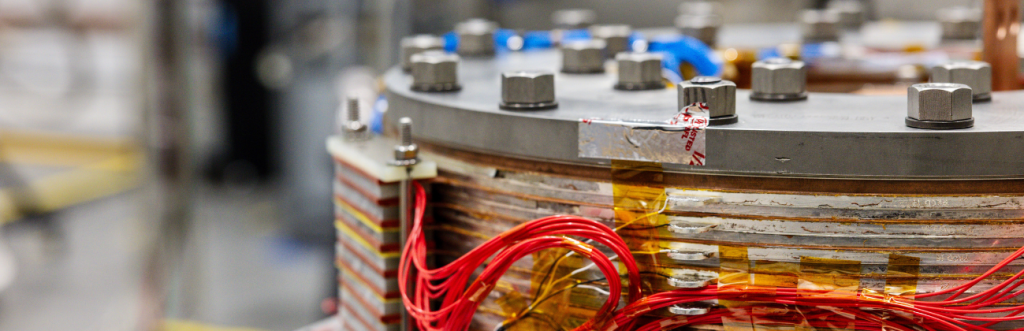
Every layer of tape and every bolt in this coil has to be reproduced identically hundreds of times over for HTS magnet manufacturing to work as a factory process rather than a lab build
(Image courtesy of Thea Energy)
Thea Energy has won a $20 million ARPA-E SCALEUP award that the company says will fund the first domestic production line for its modular high-temperature superconducting magnets. The award is less about the funding total and more about a manufacturing question: whether Thea’s stellarator coils, refined over more than a hundred design iterations, can now move from validated prototypes to repeatable, at-cost production.
Why HTS magnet manufacturing scale-up matters now
The award places Thea inside a small, selective cohort. ARPA-E’s SCALEUP Ready program selected only two projects this round, committing up to $40 million total, and Thea’s $20 million is the fusion-sector share of that commitment.
The timing also matters. ARPA-E made the award months after pledging $135 million for fusion technology in April 2026, its largest concentrated fusion investment to date. That commitment builds on roughly $134 million the agency has already invested in commercial fusion, funding that the agency says has catalysed more than $1.5 billion in private follow-on capital. The fusion sector ARPA-E entered in 2014 had 12 companies; today it has more than 50.
Inside Thea’s modular design approach
Thea’s Eos integrated stellarator system will use approximately 300 planar shaping coils, according to CEO and co-founder Brian Berzin. “In just a couple of years, we’ve iterated these coils over a hundred times, finalized the design, and derisked this core technology,” Berzin said, positioning the award as the transition point from design validation to manufacturing scale.
The design uses fewer part variants to control cost: twelve large magnets built from four templates, and more than 300 smaller magnets used to fine-tune the plasma, all identical and, Thea says, software-controlled. The arrangement is often described as similar to how pixels are distributed across a display. That approach, if it holds at production volume, allows looser construction tolerances than a fully custom coil set would require.
A federal bet backed by a decade of fusion investment
Thea’s magnet technology traces to ARPA-E’s BETHE program and a pivot in approach. A Princeton Plasma Physics Laboratory project originally set out to build a permanent-magnet stellarator, but a neodymium price increase of more than 200 percent between 2019 and 2022 pushed that plan outside its budget. That shift led the team toward arrays of planar HTS coils instead, an approach that led directly to Thea’s spinout from Princeton and PPPL in 2022.
Since then, Thea has been named an inaugural awardee of the DOE’s Milestone-Based Fusion Development Program and has drawn six separate DOE INFUSE awards alongside the new SCALEUP funding. The award also follows a run of recent milestones: a $100 million Series B raise, an HTS magnet validation campaign, and a design review for the company’s Helios power plant concept.
What HTS magnet manufacturing scale-up means for supply chains
The manufacturing question is ultimately a reactor economics question. ARPA-E’s own program materials put commercial REBCO tape cost at roughly $300 per kiloampere-meter today, against a target near $10 per kiloampere-metre for HTS-based fusion systems to become commercially cost-competitive. Thea’s award funds a production line aimed at closing that gap, one step in the broader push to bring HTS-based fusion systems to commercial cost parity.
For procurement and supply chain readers, the more durable signal is domestic sourcing. ARPA-E frames SCALEUP as support for “domestic energy supply chains,” and Thea’s award funds a U.S.-based line in Kearny, New Jersey, rather than reliance on existing REBCO tape suppliers overseas. ARPA-E has separately supported HTS magnet development at Commonwealth Fusion Systems, underscoring that magnet manufacturing capacity, not just physics validation, is now a competitive front across the sector.
How well the manufacturing line holds cost and tolerance targets will determine whether Thea can move from prototype runs to the volumes Eos requires. The company has repeatedly said it is on track to bring Eos online by 2030, with its Helios commercial power plant following in the 2030s, a timeline that now depends as much on magnet factories as on plasma performance.
Stay ahead in the fusion revolution explore more breakthroughs from leading innovators in clean energy technology.