Thea Energy and MIT to test planar encircling coil at full force
Category: Cryogenics, Magnets, Stellerator, Superconductors

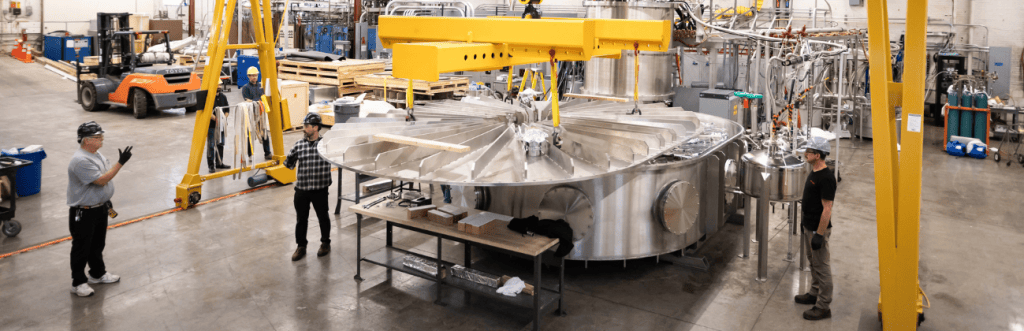
Thea’s optimisation work has the planar encircling coils generating the majority of the equilibrium’s magnetic field
(Image courtesy of Thea Energy)
Thea Energy will test a full-field, full-force planar encircling coil with MIT’s Plasma Science and Fusion Center (PSFC), building on the full-size shaping coil it reported validating in May this year. The encircling coils are designed to carry most of the Eos stellarator’s confining field, and alongside the magnet tests the programme covers efficiency analysis under power-plant-relevant conditions and resilience testing aimed at high plant availability.
The coils that carry most of the field
Eos uses 12 encircling coils and about 300 programmable shaping magnets. The encircling coils supply the toroidal flux much as toroidal field coils do in a tokamak, and in Thea’s optimisation work they generate the majority of an equilibrium’s magnetic field, leaving arrays of smaller shaping coils to fine-tune it.
The shaping coils are modular and can be replaced and adjusted in strength. Thea says it has built and validated them at scale, and in May this year its first full-size, full-current Eos-spec shaping coil produced a field above 6 tesla at 20 kelvin, after more than 50 generations of planar coil magnets developed in-house over about a year and a half.
Full force at PSFC
At PSFC the coil will be tested at full magnetic field and full force, using the centre’s cryogenic test facilities and its high-temperature superconducting (HTS) magnet expertise. Zachary Hartwig, head of the PSFC Engineering Group, called the centre’s testing infrastructure “ideally suited” to evaluating Thea’s encircling coils, and Brian Berzin, Thea’s co-founder and CEO, said the expanded collaboration adds MIT expertise to a team that already brings together national laboratories and industry leaders.
Large HTS coil testing is familiar ground for the centre, which built a dedicated superconducting magnet test facility for the SPARC toroidal field model coil, a representative-scale coil of roughly three metres developed with Commonwealth Fusion Systems that reached a peak field of about 20 tesla at the conductor. Thea designed and manufactured the shaping coils in-house at its Kearny headquarters, and the encircling coil programme draws on external test infrastructure and expertise.
Planar coils and plant availability
Planar coils are Thea’s answer to the complexity of earlier stellarator designs, whose three-dimensional coils were expensive to manufacture because of extreme precision requirements. Its flatter, simpler magnets are intended to lower cost and construction complexity, reduce maintenance cycles and increase uptime.
The efficiency analysis will build predictive models of the kind used in Thea’s digital twin work with NVIDIA and others, while the resilience testing is meant to support reliability and high plant availability. The stated aim of the Thea Energy and MIT collaboration is to accelerate the de-risking of key milestones on Thea’s path to commercial fusion by 2035.
Stay ahead in the fusion revolution explore more breakthroughs from leading innovators in clean energy technology.