First Light Fusion validates FLARE’s compression principle on M3
Category: Drivers, Inertial

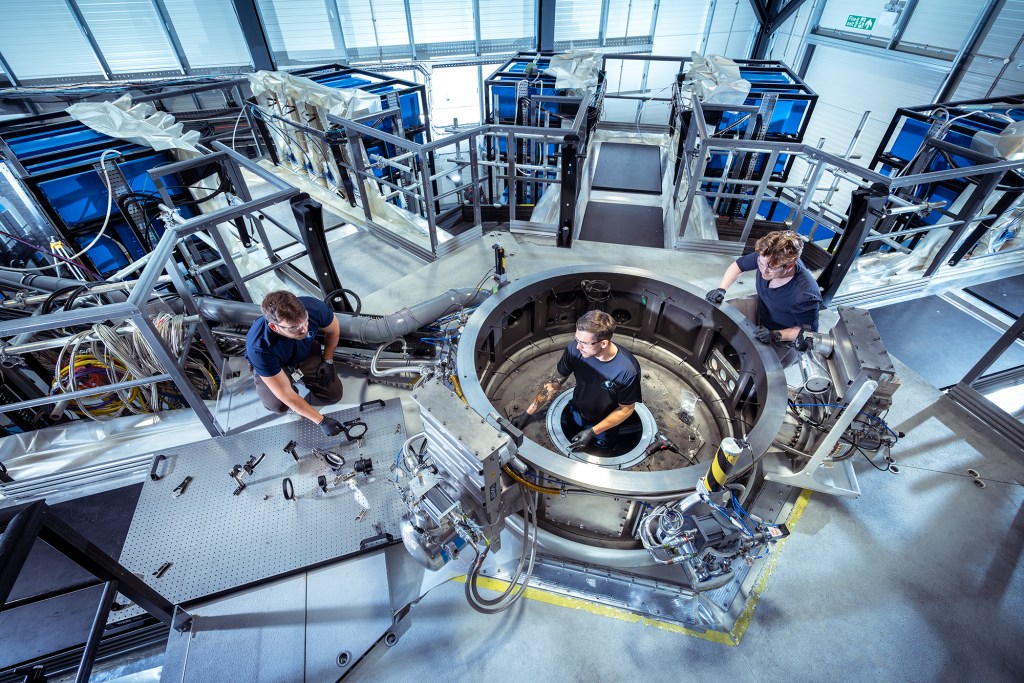
The scale problem in one frame, a target chamber built for human hands, sitting inside a driver system engineered to need less from them
(Image courtesy of First Light Fusion)
First Light Fusion has proven the fuel compression stage behind FLARE, its inertial fusion architecture, in a series of shots on M3, the Oxford company’s in-house pulsed power facility. The experiments compressed fuel to high density using a simpler, lower power driver than conventional inertial fusion machines typically require. Compression hardware is where inertial fusion burns money, since high-precision shots stress components, and stressed components fail, get maintained, sit idle. First Light’s result goes after that cost line directly, ahead of any question of gain.
Why FLARE splits compression from ignition
FLARE, short for Fusion via Low-power Assembly and Rapid Excitation, divides inertial fusion into two separate steps rather than one. The system first assembles fuel to high density, then delivers a distinct, rapid burst of energy to trigger fusion, much like an engine compresses fuel before ignition. M3 validated only the first half of that. Its multi-shell target turns a relatively simple electrical pulse into a carefully timed series of shock waves, doing mechanically what a conventional driver would otherwise have to do electrically.
Conventional inertial fusion drivers typically have to deliver huge amounts of energy with exceptional precision, and repeating that under load is hard on a machine. Push more of the compression work into the target instead, and the driver gets to be simpler and more forgiving, First Light’s case for a driver that costs, it estimates, an order of magnitude less than comparable inertial fusion systems.
The compression case FLARE just made
M3 wasn’t built to demonstrate ignition or fusion gain. It tested the compression principle alone, and nothing beyond it. That distinction is worth holding onto, because when First Light unveiled FLARE in September 2025, it put a long-term target gain of 1,000 on the table. National Ignition Facility‘s current record, set in April 2025, is a target gain of 4.13 from a 2.08 megajoule laser shot, according to Lawrence Livermore National Laboratory. This week’s result sits ahead of that comparison rather than inside it, the piece of physics FLARE’s cost case depends on before gain becomes the relevant question.
“This experiment validates a central principle of FLARE,” said chief executive Mark Thomas, “that we can simplify the machine by putting more functionality into the target.” He called it an important step in reducing risk on the path to commercially viable fusion energy. Prof Jeremy Chittenden, chair of First Light’s science advisory board and professor of plasma physics and director of the Centre for Inertial Fusion at Imperial College, was more clinical about it, calling the compressed multi-shell liners on a low voltage generator “a significant step on the path to validating the science behind FLARE.”
What First Light’s £25 million delivered
This week’s result follows the £25 million funding round First Light announced as a first close in April, and the company is calling it a major technical milestone. The staged programme now moves toward fusion relevant fuel conditions, then integrated experiments combining compression with the rapid heating needed to trigger fusion, though First Light hasn’t put dates on either.
A cheaper, more robust driver would change the capital and maintenance profile of any future FLARE facility. That’s the number procurement teams and investors can actually weigh today, ahead of anything to do with gain.
What the next FLARE milestone needs to show
The next marker in First Light’s programme pairs the now-validated compression stage with rapid ignition in an integrated shot, not just compression alone. Until fusion relevant fuel conditions and that combined shot arrive, FLARE’s cost advantage is a design target, not a measured one. Gain, however small, is what starts the NIF comparison. Until then, First Light has proven a narrower but load-bearing piece of its cost case, and the multi-shell target concept behind it has cleared a first, genuinely non-trivial test.
Stay ahead in the fusion revolution explore more breakthroughs from leading innovators in clean energy technology.